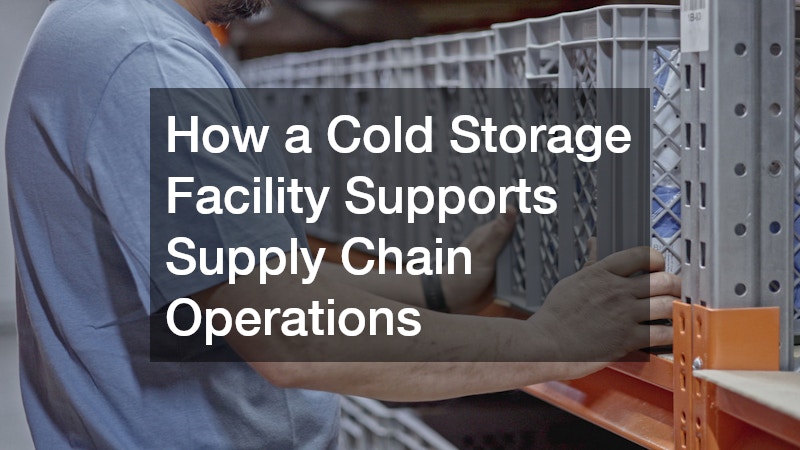
Modern supply chains depend on careful coordination between suppliers, manufacturers, warehouses, distributors, retailers, and customers. For products that require specific temperature conditions, maintaining quality throughout this journey presents additional operational challenges. Food, beverages, pharmaceuticals, agricultural products, and other temperature-sensitive goods can be affected by heat, humidity, and fluctuations in storage conditions.
A cold storage facility provides controlled conditions that help businesses manage these products between different stages of the supply chain. Beyond simply keeping goods cold, temperature-controlled storage can support inventory management, product quality, distribution planning, and operational efficiency.
When incorporated into a broader logistics strategy, cold storage can help businesses maintain consistency from receiving through final delivery.
Maintaining Product Quality
Product quality is a major consideration when handling temperature-sensitive goods. Exposure to unsuitable temperatures can affect freshness, shelf life, appearance, safety, or performance, depending on the product.
Temperature-controlled environments help businesses maintain conditions appropriate for the goods being stored. Consistent refrigeration or freezing can reduce exposure to temperature fluctuations that could otherwise compromise products.
Maintaining quality can also reduce operational problems later in the supply chain. When products arrive at distribution centers or retailers in good condition, businesses may experience fewer damaged goods, customer complaints, returns, and product losses.
Supporting Inventory Management
Effective inventory management requires businesses to know what products they have, where those products are located, and when they need to be moved. Temperature-sensitive inventory adds another layer of complexity because storage conditions must be maintained while products remain in the warehouse.
A cold storage facility can support organized inventory practices by providing designated areas for products with different temperature requirements. Businesses can establish procedures for receiving, labeling, rotating, monitoring, and shipping inventory.
Proper inventory rotation is particularly important for perishable products. Methods such as first-in, first-out can help businesses move older inventory before newer shipments, potentially reducing spoilage and unnecessary waste.
Managing Different Temperature Requirements
Not every temperature-sensitive product requires the same storage environment. Some products may need refrigeration, while others require freezing or more closely controlled conditions.
A cold storage facility can be designed or organized to accommodate different temperature requirements, depending on its capabilities. Separating products according to their storage needs can help reduce the risk of inappropriate conditions.
Operational procedures should also account for transitions between environments. Receiving, staging, loading, and unloading can create opportunities for products to experience temperature changes. Clear processes can help minimize unnecessary exposure during these activities.
Using Technology for Better Monitoring
Technology has become increasingly important in modern warehouse operations. Temperature sensors, automated monitoring systems, inventory management platforms, barcode systems, and other tools can help businesses track conditions and product movement.
Temperature monitoring systems can provide information about storage conditions and may alert personnel when temperatures move outside established parameters. This allows employees to investigate potential problems before they have a larger impact on inventory.
Inventory technology can also improve visibility. Businesses can use digital records to track quantities, locations, expiration dates, and movement through the warehouse. Better visibility can support more informed decisions about purchasing, storage, and distribution.
Improving Operational Efficiency
Efficiency involves more than moving products quickly. It also requires reducing unnecessary labor, minimizing errors, using available space effectively, and maintaining consistent processes.
A well-organized cold storage facility can support these goals through thoughtful layout and workflow planning. Storage areas, receiving zones, staging spaces, and loading areas can be arranged to support efficient product movement.
Standardized procedures can also make daily operations more predictable. Employees can follow established processes for receiving shipments, inspecting products, recording inventory, monitoring temperatures, rotating stock, and preparing orders.
When workflows are consistent, businesses may have an easier time identifying bottlenecks and determining where improvements are needed.
Supporting Business Growth
As companies expand, their supply chain requirements often become more complex. Increased sales volume can mean more inventory, additional customers, larger shipments, and greater pressure on distribution operations.
Having access to reliable temperature-controlled storage can provide additional capacity as demand changes. Businesses may use this capacity to support seasonal increases, enter new markets, or accommodate larger customer orders.
Scalable storage solutions can also help companies avoid making rushed operational decisions during periods of growth. Instead of relying on temporary arrangements that may not provide appropriate conditions, businesses can develop a more structured approach to temperature-sensitive inventory.
Strengthening Supplier and Customer Relationships
Supply chain performance can influence relationships throughout a business network. Suppliers want confidence that their products will be handled appropriately, while customers expect orders to arrive in suitable condition and within the agreed timeframe.
Reliable temperature-controlled operations can support these expectations. Consistent storage procedures, inventory visibility, and distribution planning can help businesses maintain dependable service.
Strong operational performance can also contribute to customer satisfaction. When products arrive in expected condition, businesses are better positioned to maintain consistent quality and reduce avoidable service issues.
Temperature-sensitive products require careful planning at every stage of the supply chain. A cold storage facility can support this process by providing controlled environments for inventory while helping businesses manage product quality, storage, distribution, and operational efficiency.
From reducing waste and improving inventory management to supporting technology-driven monitoring and more flexible distribution planning, temperature-controlled storage can serve an important role in modern logistics. As supply chains become increasingly complex, businesses that handle perishable or temperature-sensitive products can benefit from treating cold storage as an integral part of their overall operations strategy rather than simply a place to keep products cold.

About the Author